What is the most popular thing to resell on eBay?
If you are thinking about starting an eBay business, one question probably comes before everything else:
What is the most popular thing to resell on eBay right now?
The obvious answer would be electronics.
But the real answer is more interesting.
There is no single product that stays at the top forever. eBay is a massive marketplace with millions of products, and buyer demand changes constantly. Some categories generate enormous sales volume, while smaller niches can produce much better opportunities for individual sellers.
The key is not simply finding “the most popular product.”
It is finding products that have demand, reasonable competition, healthy margins, and a realistic chance of selling consistently.
And eBay now gives sellers something extremely valuable: actual marketplace sales data.
eBay Is Still a Huge Marketplace in 2026
Before looking at individual products, consider the size of the opportunity.
According to eBay’s latest reported results, eBay had approximately 136 million active buyers in Q2 2026.
During the same quarter, eBay generated approximately $22.4 billion in Gross Merchandise Volume (GMV), representing 15% year-over-year growth.
That means there is still enormous buying activity taking place on the platform.
And this is important for new sellers.
You do not need millions of customers.
You need to find a small part of eBay’s enormous demand and build listings that successfully capture it.
So, What Is the Most Popular Thing to resell on eBay?
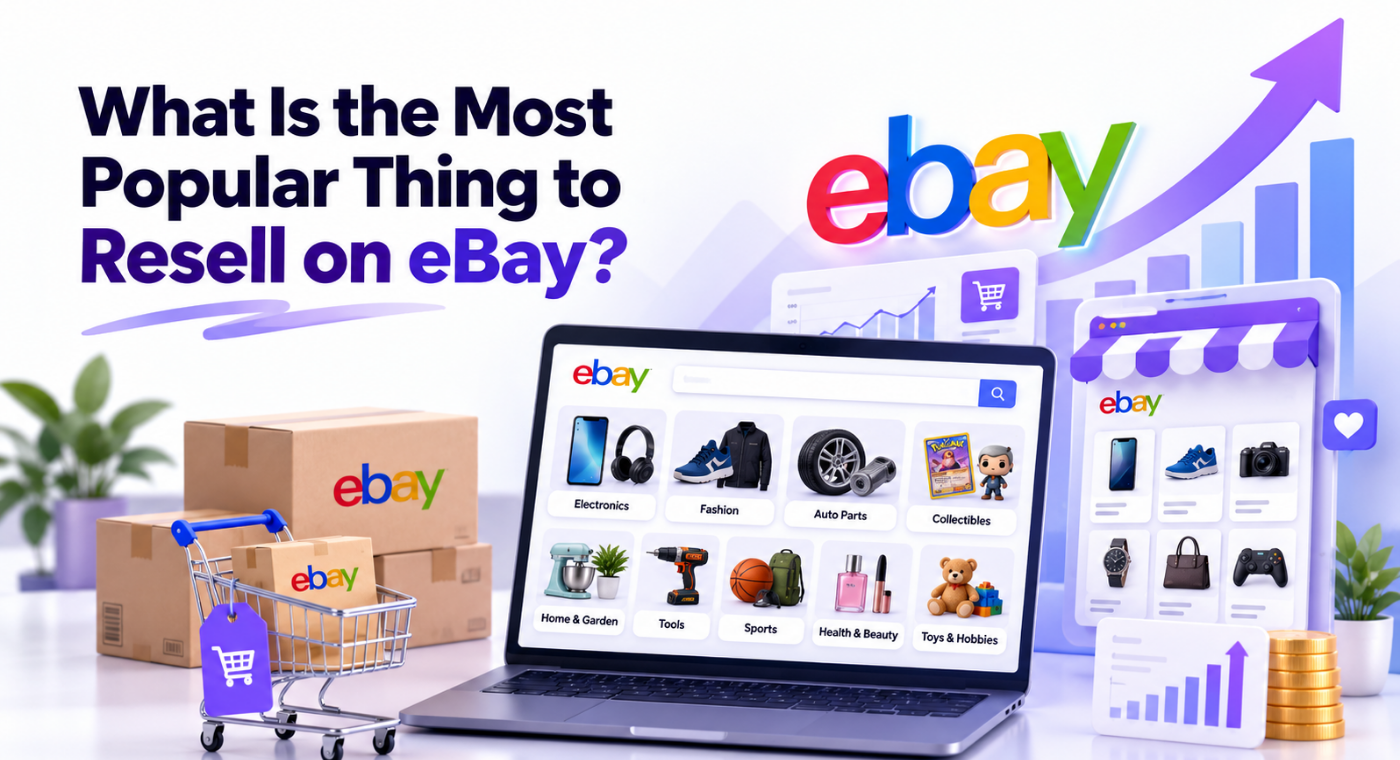
If we look at eBay’s marketplace categories and current marketplace activity, several categories repeatedly stand out:
- Electronics
- Fashion and footwear
- Auto parts and accessories
- Collectibles and trading cards
- Home & Garden
- Tools and industrial products
- Sports and outdoor products
- Health & Beauty
- Toys and hobbies
- Computer equipment and accessories
eBay itself highlights categories such as Electronics, Motors, Fashion, Collectibles & Art, Sports, Health & Beauty, Industrial Equipment, and Home & Garden among its major marketplace categories.
But there is a major difference between a category being popular and a product being a good opportunity.
That distinction can save a new seller from wasting hundreds or thousands of dollars.
1. Electronics Are One of the Biggest Reselling Opportunities
Electronics are one of the first categories most sellers investigate, and for good reason.
eBay’s marketplace prominently features:
- Smartphones
- Computers
- Tablets
- Headphones
- Smartwatches
- Cameras
- Gaming products
- Computer components
- Networking equipment
- Smart-home products
- Accessories
Amazon’s Best Sellers pages also show strong consumer demand for products such as AirTags, AirPods, Fire TV devices, and other electronics.
But here is the problem:
Popular does not automatically mean profitable.
An iPhone might sell extremely well, but that doesn’t mean a new seller should immediately start selling iPhones.
Why?
Because high-demand products often attract:
- More competition
- Lower margins
- Experienced sellers
- Price competition
- Counterfeit concerns
- Returns
- Warranty issues
- Higher capital requirements
A $10 accessory can sometimes be a better business opportunity than a $1,000 smartphone.
That’s why smart sellers research individual products rather than simply choosing a broad category.
2. Fashion Is Another Major eBay Category
Fashion is another huge opportunity.
eBay reported that fashion generated more than $10 billion in annual GMV and that U.S. fashion GMV grew 10% year over year in 2025.
That includes products such as:
- Sneakers
- Shoes
- Clothing
- Watches
- Jewelry
- Bags
- Accessories
- Vintage fashion
- Pre-owned designer products
The secondhand market is particularly interesting.
eBay’s 2025 Recommerce Report found that clothing and shoes lead among buyers of pre-loved products, while collectibles, trading cards and vintage products also generate strong community-driven demand.
This is a major reason why experienced eBay sellers don’t necessarily chase only brand-new products.
Sometimes the opportunity is sitting inside products other people no longer want.
3. Auto Parts Can Be Surprisingly Powerful
If someone asks:
“What sells on eBay that isn’t saturated with generic products?”
Auto parts deserve serious consideration.
eBay has an enormous Motors marketplace containing categories such as:
- Auto parts
- Motorcycle parts
- Tools
- GPS and electronics
- Engine components
- Exhaust systems
- Suspension parts
- Accessories
The advantage of auto parts is that buyers frequently search for very specific products.
For example, someone isn’t necessarily looking for “a car accessory.”
They may be searching for:
2018 Honda Civic rear brake caliper
That is a much more specific buying intent.
When someone knows exactly what they need, price and availability can become much more important than brand storytelling or flashy advertising.
4. Collectibles and Trading Cards Can Create Extremely Strong Demand
Collectibles are another category worth watching.
Think:
- Pokémon cards
- Sports cards
- Trading card games
- Action figures
- LEGO
- Diecast vehicles
- Vintage toys
- Movie memorabilia
- Comics
- Limited-edition products
The interesting thing about collectibles is that demand can be driven by communities rather than ordinary consumer shopping.
A collector who wants a specific card may search for that exact card repeatedly.
That creates opportunities for sellers who understand the niche.
But there is also a major warning:
You need to know what you are selling.
Condition, authenticity, edition, grading, rarity, and variations can completely change the value of a collectible.
5. Home & Garden Products Are Often Easier for Beginners
Home & Garden is another enormous marketplace.
Products can include:
- Kitchen accessories
- Storage products
- Lighting
- Home improvement tools
- Garden equipment
- Organization products
- Small appliances
- Patio products
- DIY accessories
The advantage is variety.
You can potentially find products with:
- Low purchase costs
- Lightweight shipping
- Simple product descriptions
- Broad consumer demand
- Multiple variations
The disadvantage is that generic products can become extremely competitive.
A product isn’t attractive simply because it is cheap.
You need to know whether people are actually buying it.
The Biggest Mistake New eBay Sellers Make
Here is where most “best products to sell on eBay” articles get it wrong.
They give you a list such as:
“Sell electronics, shoes, toys and home products.”
That’s not enough.
Thousands of other sellers already know those categories.
The real question should be:
Which specific products inside those categories are actually selling right now?
Fortunately, eBay has an official answer.
Use eBay Product Research Instead of Guessing
eBay’s Product Research tool gives sellers access to real marketplace data.
According to eBay, Product Research provides access to three years of sales data for millions of items.
Depending on the product, sellers can analyze:
- Sales trends
- Average selling price
- Sold price range
- Shipping costs
- Number of sellers
- Sell-through rate
- Sales format
- Market trends
This is dramatically better than choosing products based on YouTube videos or random “top 10 products” articles.
eBay also provides Sourcing Insights for eligible sellers, helping identify categories where demand is high relative to inventory.
What Should You Actually Look For?
Instead of asking:
“What is the most popular product on eBay?”
Ask these five questions:
1. How many units are selling?
A product with thousands of sales has demonstrated demand.
2. How many sellers are competing?
High sales with enormous competition may still produce terrible margins.
3. What is the average selling price?
You need enough room between your total cost and selling price.
4. What is the sell-through rate?
This can help you understand how quickly demand is moving relative to available listings.
5. Can you source it reliably?
This is one of the most important questions.
A product can be incredibly popular, but if you cannot reliably source it, your business will eventually run into problems.
A Simple Product Research Formula
Before listing a product, think about it like this:
Potential Profit = Selling Price − Product Cost − eBay Fees − Shipping − Returns/Other Costs
For example:
Suppose a product sells for $49.99.
Your total costs might look like:
- Product: $25
- eBay fees: $7
- Shipping: $6
- Other costs: $2
Estimated profit:
$49.99 − $25 − $7 − $6 − $2 = $9.99
That is approximately a $10 profit.
Now imagine finding a product that sells 100 times per month.
That’s potentially:
100 × $10 = $1,000 gross profit before other business expenses.
This is why product selection matters more than simply listing thousands of random products.
Real eBay Success Stories Prove That Niches Matter
eBay has published seller success stories showing how businesses have built significant operations around specific product categories.
One example is ZYDistro.
The company built a large eBay business around wireless accessories and reported shipping approximately 3,000 wireless accessories per day. eBay says the company had more than one million items in stock while scaling its operation.
Another example is Apparel Zoo, a fashion business that reported going from zero to approximately $50,000 per month in sales within about two months after finding traction on eBay.
The lesson isn’t that you should sell wireless accessories or clothing.
The lesson is:
Successful sellers usually find a market and execute extremely well instead of randomly listing whatever looks popular.
The Product Doesn’t Have to Be “Viral”
This is one of the biggest misconceptions about eBay.
You don’t necessarily need the next viral product.
A boring product can make money.
Consider products such as:
- Replacement parts
- Cable adapters
- Storage accessories
- Specialized tools
- Replacement filters
- Small electronics accessories
- Automotive components
- Office accessories
- Hobby supplies
These products may never become viral on TikTok.
But someone who needs one may be ready to buy immediately.
That is valuable.
Why “Boring” Products Can Be Better
Imagine two products.
Product A
10,000 sellers are competing for a trendy product.
Product B
Only 150 sellers are competing for a specialized replacement component.
Product A may have much higher search volume.
But Product B may have:
- Less competition
- Higher buyer intent
- Better margins
- Lower advertising costs
- More repeat demand
That’s why professional sellers analyze the data instead of chasing hype.
What About Amazon to eBay Dropshipping?
This brings us to the model many new sellers are interested in.
The basic idea is simple:
- Find products with demand.
- List them on eBay.
- Wait for an eBay customer to purchase.
- Purchase the product from a supplier.
- Have the supplier fulfill the order.
- Keep the difference between your selling price and total costs.
The appeal is obvious.
You don’t need to purchase hundreds of products upfront.
You don’t need a warehouse.
And you can test many products before committing significant capital.
However, there is an important distinction that every seller needs to understand.
Important: eBay’s Dropshipping Policy
eBay currently states that dropshipping is permitted when the seller owns the inventory before listing it or has an agreement with a wholesale supplier to list and sell the products.
eBay specifically says that purchasing an item from another retailer or marketplace after the eBay sale and having that retailer ship directly to the buyer is not permitted under its policy.
That means sellers should not assume that using Amazon Prime to fulfill an eBay order automatically makes Amazon-to-eBay dropshipping compliant with eBay’s rules.
This is an important distinction that many dropshipping websites fail to mention.
If you want to build a long-term eBay business, you should structure your sourcing and fulfillment around eBay’s current policies rather than trying to hide the source of the product.
Where A2E Dropshipping Comes In
At A2E Dropshipping, our goal is to make the product research and listing side of an eBay business easier.
You don’t necessarily need to begin by buying a warehouse full of inventory.
You can start by researching products, analyzing demand and competition, and building a catalog around products that have a realistic opportunity to sell.
The important part is having a sourcing and fulfillment process that can actually support the business.
For sellers exploring Amazon-to-eBay workflows, we can also help with product research and listing processes.
A Real Client Example
Below is an example from one of our clients showing the relationship between an eBay order and the corresponding Amazon purchase.
Example Amazon purchase order associated with an eBay store order.

Corresponding eBay customer order from the client’s store.

These screenshots demonstrate how the workflow can look operationally.
However, sellers should understand that using Amazon as a retailer to fulfill an eBay order after the sale can conflict with eBay’s current dropshipping policy. The safer long-term approach is to work with suppliers and fulfillment arrangements that meet eBay’s requirements.
You Don’t Need to Start With a Warehouse
This is perhaps the biggest advantage of modern e-commerce.
You don’t necessarily need:
- A warehouse
- Thousands of dollars in inventory
- Employees
- Packaging equipment
- A physical storefront
to begin researching and building an eBay business.
What you do need is:
- Product research
- Reliable suppliers
- Competitive pricing
- Good listings
- Accurate product information
- Fast fulfillment
- Excellent customer service
- A clear understanding of marketplace policies
eBay itself recommends using real sales data to determine what to sell, when to sell it and how to price it.
The Bottom Line: What Is the Most Popular Thing to Resell on eBay?
If you want one simple answer:
There isn’t one single “most popular” product that every eBay seller should resell.
Instead, some of the strongest categories include:
Electronics: Huge demand, but intense competition.
Fashion: Massive marketplace with strong pre-owned and branded demand.
Auto Parts: Excellent opportunity for highly specific searches.
Collectibles: Strong communities and passionate buyers.
Home & Garden: Huge range of products and opportunities.
Tools & Industrial: Often overlooked, but potentially valuable niches.
Sports & Hobbies: Strong demand around specialized products.
The smartest approach isn’t to ask:
“What is everyone selling?”
Ask:
“What are buyers actually purchasing, how much are they paying, how many sellers are competing, and can I source the product profitably and compliantly?”
That is the difference between randomly listing products and building an actual eBay business.
Start With Research, Not Inventory
If you’re new to eBay, don’t rush out and spend $5,000 on inventory.
Start smaller.
Research products.
Check sold prices.
Analyze competition.
Calculate the complete cost.
Test your listings.
Measure what happens.
Then increase your inventory and product range based on actual results.
eBay gives sellers access to years of marketplace sales information through Product Research, so there is little reason to make product decisions completely blind.
And remember:
The most popular product isn’t necessarily the best product for you.
The best product is the one where demand, competition, sourcing, fulfillment, and profit all make sense together.
Ready to Start Amazon-to-eBay Dropshipping?
If you are interested in starting an Amazon-to-eBay dropshipping business, A2E Dropshipping can help you with product research, listing creation, and store management.
You don’t need to start by buying large amounts of inventory or renting a warehouse.
Start by identifying products with proven demand, build your listings, analyze your results, and scale the products that actually perform.
If you choose to use Amazon as a fulfillment source, make sure your process complies with the latest eBay policies and that you understand the risks before scaling.
The goal isn’t simply to list 1,000 products.
The goal is to build an eBay store that sells.
Start Your Amazon-to-eBay Dropshipping Journey with A2E Dropshipping