
How Many Items Should I List Daily on eBay? 5,10 or 15?
 support@a2edropshipping.com
10 min read
On this page
- How Many Items Should I List Daily on eBay?
- What If I Have an Aged eBay Account?
- Why 10 New Listings Per Day Can Make Sense
- Should You List 10 Items Every Day?
- How Many Products Should You List on eBay?
- Why We Recommend Working Toward 500+ Products
- More Listings Do Not Automatically Mean More Sales
- What Should I List Each Day?
- 1. Demand
- 2. Competition
- 3. Price
- 4. Shipping
- 5. Availability
- 6. Product Quality
- 7. Return Risk
- 8. Profitability
- Don't Upload 10 Random Products Just to Hit 10
- What Happens If You List 10 Products Every Day?
- After 1 Week
- After 1 Month
- After 2 Months
- After 3 Months
- Why a 500+ Product Catalog Can Be Useful
- Managing 500+ Listings Is the Hard Part
- Use AutoDS to Help Monitor Pricing and Stock
- Why Automated Price Monitoring Matters
- Why Stock Monitoring Matters
- What If My eBay Account Has Low Selling Limits?
- What If I Can List More Than 10 Items Per Day?
- What Should You Do With Products That Don't Sell?
- High Impressions + Low Clicks
- High Clicks + Low Sales
- Sales + Low Profit
- Consistent Sales + Healthy Margin
- Almost No Activity
- A Simple Daily eBay Listing Strategy
- Morning
- Midday
- Listing Session
- After Listing
- Ongoing
- Weekly
- How A2E Dropshipping Can Help
- How Many Items Should You List Daily on eBay? Final Answer
- The Bottom Line
How Many Items Should I List Daily on eBay? 5,10 or 15?
If you’re building an eBay store, one of the most common questions is:
How many items should I list daily on eBay?
Should you list 2 items a day?
5?
10?
50?
Or should you upload hundreds of products at once?
There is no single number that applies to every eBay seller. Your account’s selling limits, history, product category, listing quality, sourcing, fulfillment capacity, and overall seller performance all matter.
However, if you have an aged eBay account that was created in a previous year and has appropriate selling limits, listing at least 10 relevant products per day can be a practical target for steadily building your catalog.
That would mean approximately:
- 10 listings per day
- 70 listings per week
- 300 listings per 30-day month
At that pace, you could potentially build a catalog of 500+ products in less than two months, assuming your account limits allow it.
But there is an important distinction:
10 listings per day is a practical growth strategy, not an official eBay requirement.
Your actual listing volume should always remain within your current eBay selling limits and your ability to properly manage the catalog.
How Many Items Should I List Daily on eBay?
For many established sellers, 10 new listings per day is a reasonable starting target for consistent catalog growth.
Why 10?
Because it creates a steady publishing schedule without requiring you to upload hundreds of products at once.
At 10 listings per day:
| Time Period | New Listings |
|---|---|
| 1 day | 10 |
| 7 days | 70 |
| 14 days | 140 |
| 30 days | 300 |
| 60 days | 600 |
| 90 days | 900 |
This demonstrates why daily listing can be powerful.
You don’t necessarily need to upload 500 products in one day.
You can build a substantial catalog simply by consistently adding products.
What If I Have an Aged eBay Account?
If your eBay account was created several years ago, you may have more account history than someone who opened an account yesterday.
However, account age alone does not guarantee higher selling limits.
Your current selling limits and account status matter.
Before following a 10-items-per-day strategy, check your actual limits in eBay Seller Hub.
If your account allows you to list substantially more than 10 items, you can potentially use 10/day as a conservative catalog-building pace.
If your account only allows a smaller number, stay within that limit.
Don’t try to bypass eBay’s restrictions simply to reach a particular daily listing target.
Why 10 New Listings Per Day Can Make Sense
Listing consistently gives you a simple and measurable growth strategy.
Instead of saying:
“I’ll upload 500 products someday.”
You can set a daily target:
“I’ll research and list 10 relevant products today.”
Do that consistently and the catalog grows naturally.
After one week:
70 products
After one month:
300 products
After two months:
600 products
That’s enough to build a substantial product catalog without requiring one massive upload session.
Should You List 10 Items Every Day?
Not necessarily.
The number should depend on your available selling limits and the quality of your product research.
If you can find only five genuinely suitable products on a particular day, uploading five good products is better than adding five poor products just to hit a number.
The goal should be:
Consistent listing + quality products + proper management.
Not:
Maximum listing count at any cost.
How Many Products Should You List on eBay?
This is the bigger question behind daily listing.
Your daily target determines how quickly your overall catalog grows.
For example, if you list approximately 10 products per day:
10 × 30 = approximately 300 new listings per month.
Continue for another month and you could reach approximately:
600 new listings.
This makes 500+ products a practical long-term catalog target for sellers who have the account capacity and systems to manage that many products.
But again, 500 is not an eBay requirement.
It’s a business-growth target.
Why We Recommend Working Toward 500+ Products
At A2E Dropshipping, we believe sellers should think beyond individual products and build a broader catalog.
Imagine you have 30 products.
You may have only a limited number of opportunities to discover which products work for your store.
Now imagine you have 500 carefully researched products.
You have considerably more products that can potentially attract different types of buyers.
A larger catalog allows you to collect more data about:
- Product demand
- Buyer interest
- Clicks
- Impressions
- Sales
- Conversion
- Pricing
- Profit margins
- Product categories
- Customer questions
- Returns
The purpose of a larger catalog isn’t to assume everything will sell.
The purpose is to create more opportunities to discover what works.
More Listings Do Not Automatically Mean More Sales
This is extremely important.
Listing 500 products does not guarantee 500 sales.
In fact, you could list 1,000 products and still have poor sales if:
- The products have little demand
- Your prices are uncompetitive
- Your listings are poorly optimized
- Your images are weak
- Your descriptions are inaccurate
- Your shipping terms aren’t competitive
- Products become unavailable
- Your margins are too small
That’s why we recommend combining catalog growth with product research and optimization.
Quantity creates opportunities. Quality determines whether those opportunities are useful.
What Should I List Each Day?
Don’t treat your daily listing target as a random number.
Use a product-selection process.
Before listing a product, consider:
1. Demand
Are buyers actually searching for and purchasing this type of product?
2. Competition
How many competing sellers are offering similar products?
3. Price
Can you offer a competitive price while maintaining a reasonable margin?
4. Shipping
Can the product be delivered within the timeframe promised to the customer?
5. Availability
Is the product reliably available through your sourcing arrangement?
6. Product Quality
Are the product specifications and information accurate?
7. Return Risk
Could the product create avoidable returns because of compatibility, sizing, quality, or unclear information?
8. Profitability
After product cost, eBay fees, shipping, advertising, returns, and other expenses, is there enough margin?
If a product fails several of these checks, it may not be worth adding just to reach your daily target.
Don’t Upload 10 Random Products Just to Hit 10
This is one of the easiest mistakes to make.
Suppose your target is 10 listings today.
You’ve found seven good products.
Don’t add three poor products simply because your spreadsheet says you need exactly 10.
A better approach is:
7 strong products > 10 weak products.
Your daily target is there to encourage consistency.
It isn’t a reason to lower your product-selection standards.
What Happens If You List 10 Products Every Day?
Let’s look at the math.
After 1 Week
10 × 7 = 70 listings
After 1 Month
10 × 30 = 300 listings
After 2 Months
10 × 60 = 600 listings
After 3 Months
10 × 90 = 900 listings
That’s why consistent listing can be more important than occasional large uploads.
You don’t have to sit down one weekend and create 500 listings.
You can build the catalog gradually.
Why a 500+ Product Catalog Can Be Useful
A catalog of 500+ products gives your store considerably more product coverage than a store with only a few dozen listings.
It can help you test:
- Different product categories
- Different price points
- Different product types
- Different buyer interests
- Different keywords
- Different seasonal products
You may discover that certain categories consistently outperform others.
You can then use that information to guide future product research.
The result is a data-driven catalog rather than a collection of products chosen entirely by guesswork.
Managing 500+ Listings Is the Hard Part
Adding products is only one part of running an eBay store.
Once you have hundreds of listings, you also need to monitor:
- Product prices
- Product availability
- Shipping information
- Orders
- Returns
- Customer messages
- Listing performance
- Supplier changes
- Profit margins
This is where catalog-management tools become increasingly useful.
Use AutoDS to Help Monitor Pricing and Stock
One tool that can help manage a larger product catalog is AutoDS.
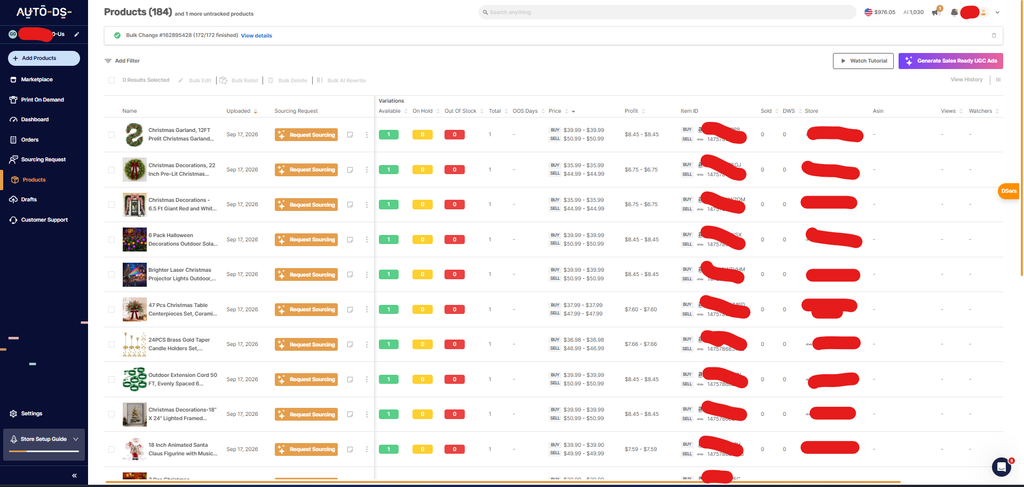
AutoDS provides price and stock monitoring for supported suppliers and can automatically update listings when monitored supplier information changes.
According to AutoDS, its monitoring system scans supplier price and stock information approximately every hour. It can detect changes and update products based on your configured settings. AutoDS price and stock monitoring
This can be particularly useful when you’re managing hundreds of listings.
Instead of manually checking every product for price and inventory changes, automation can handle much of the repetitive monitoring.
AutoDS also offers features for:
- Price monitoring
- Stock monitoring
- Automated price updates
- Automated stock updates
- Bulk product importing
- Pricing rules
- Minimum-stock settings
- Product monitoring
However, automation doesn’t mean you should completely stop reviewing your listings.
Important products and unusual changes should still be checked manually.
Why Automated Price Monitoring Matters
Imagine you list a product for $49.99.
When you create the listing, the supplier price is $25.
You calculate your costs and determine that the product appears profitable.
A week later, the supplier raises the price to $35.
Your eBay listing is still $49.99.
Your expected profit has now decreased.
If the price changes again, the margin could become even smaller.
Automated price monitoring can help detect these changes much faster than manual checking.
That’s especially valuable when you have hundreds of listings.
Why Stock Monitoring Matters
Stock availability is equally important.
Imagine you have 500 active listings.
A supplier suddenly sells out of one product.
If your listing remains active and a customer places an order, you now have a fulfillment problem.
This can potentially result in:
- Order cancellation
- Customer dissatisfaction
- Additional customer-service work
- Negative feedback
- Account-performance problems
Monitoring inventory can help reduce the risk of relying on outdated stock information.
What If My eBay Account Has Low Selling Limits?
If your account currently has a low selling limit, don’t try to force a 10-per-day strategy.
Start with what eBay allows.
Focus on:
- Good listing quality
- Accurate product information
- Reliable fulfillment
- Customer service
- Order handling
- Seller performance
As your account develops, you can reassess your catalog-building pace.
Remember:
10 listings per day is a practical target, not a requirement.
Your account’s current limits come first.
What If I Can List More Than 10 Items Per Day?
If your account allows significantly more listings and you have the systems to manage them, you don’t necessarily need to stop at 10.
For example, an experienced seller with strong automation and reliable sourcing might be able to add 20, 30, or more products per day.
But increasing the number of daily listings increases the workload associated with:
- Product research
- Listing creation
- Pricing
- Inventory
- Orders
- Customer support
- Returns
- Catalog optimization
Scaling should therefore happen alongside your ability to manage the additional volume.
What Should You Do With Products That Don’t Sell?
Don’t assume every product will perform.
That’s normal.
Once your listings have generated enough data, analyze them.
You may find products with:
High Impressions + Low Clicks
The product may need a better image, title, price, or offer.
High Clicks + Low Sales
The listing may have a pricing, shipping, product, or trust issue.
Sales + Low Profit
The product may be selling but not producing enough margin.
Consistent Sales + Healthy Margin
These products deserve closer attention and may help guide future product research.
Almost No Activity
Some products may simply not have enough demand.
The point of building a large catalog is not to keep every product forever.
It’s to learn from the data.
A Simple Daily eBay Listing Strategy
If your account is aged and has sufficient selling capacity, you could use a simple daily routine.
Morning
Research potential products.
Midday
Review product costs, availability, competition, and margins.
Listing Session
Publish approximately 10 quality products.
After Listing
Check that titles, categories, item specifics, pricing, shipping, and product information are accurate.
Ongoing
Monitor performance and supplier changes.
Weekly
Review your catalog and identify products that need optimization or replacement.
This creates a repeatable system rather than random listing activity.
How A2E Dropshipping Can Help
At A2E Dropshipping, we help eBay sellers with product research, listing creation, catalog expansion, and ongoing store management.
If you’re currently listing only a few products per week, increasing your catalog gradually can create more opportunities to test products and identify demand.
For sellers with an aged eBay account and sufficient selling limits, 10 relevant listings per day can be a practical starting target.
That works out to approximately:
300 listings per month.
And if you continue consistently, you can work toward:
500+ products
and eventually much larger catalogs.
The important part is not simply reaching a number.
It’s building a catalog that you can actually manage.
How Many Items Should You List Daily on eBay? Final Answer
So, how many items should you list daily on eBay?
For an aged eBay account with sufficient selling limits, we recommend considering at least 10 quality listings per day as a practical catalog-building target.
That’s approximately:
70 listings per week
300 listings per month
600 listings in two months
900 listings in three months
However, this isn’t an official eBay requirement.
Your actual listing limit, account status, product quality, sourcing arrangement, fulfillment capabilities, and ability to manage the catalog should determine your pace.
If you can consistently find good products, list them accurately, monitor pricing and inventory, and manage customer orders properly, increasing your catalog can create more opportunities for growth.
And when your catalog reaches hundreds of products, automation tools such as AutoDS can help reduce repetitive price and stock-monitoring work.
The Bottom Line
Don’t focus on uploading the maximum possible number of products.
Focus on building the largest quality catalog you can properly manage.
Start where your account allows you to start.
Aim for consistency.
Work toward 10 quality listings per day when appropriate.
Build toward 500+ products.
Monitor what sells.
Remove or improve weak products.
Scale the products and categories that show potential.
A larger catalog doesn’t guarantee more sales, but it gives your eBay business more opportunities to find products that buyers actually want.
And that’s the real purpose of consistent listing.

Part of the A2E Dropshipping team, helping eBay sellers research, list and grow since 2018.