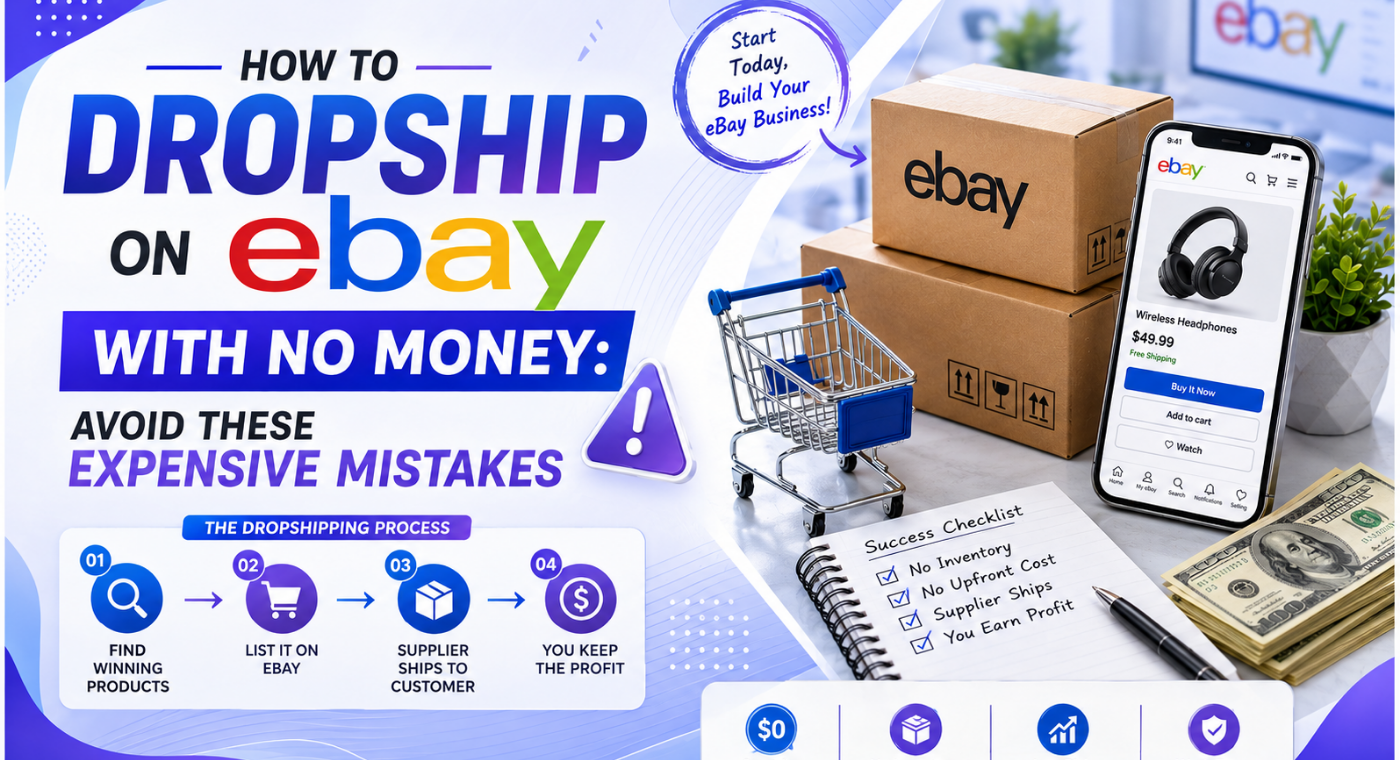
Can you start eBay dropshipping with no money? Technically, you can start with very little upfront capital because dropshipping does not require you to purchase and store large amounts of inventory before you make sales.
But there is an important distinction that many YouTube videos, blogs, and social media posts completely ignore.
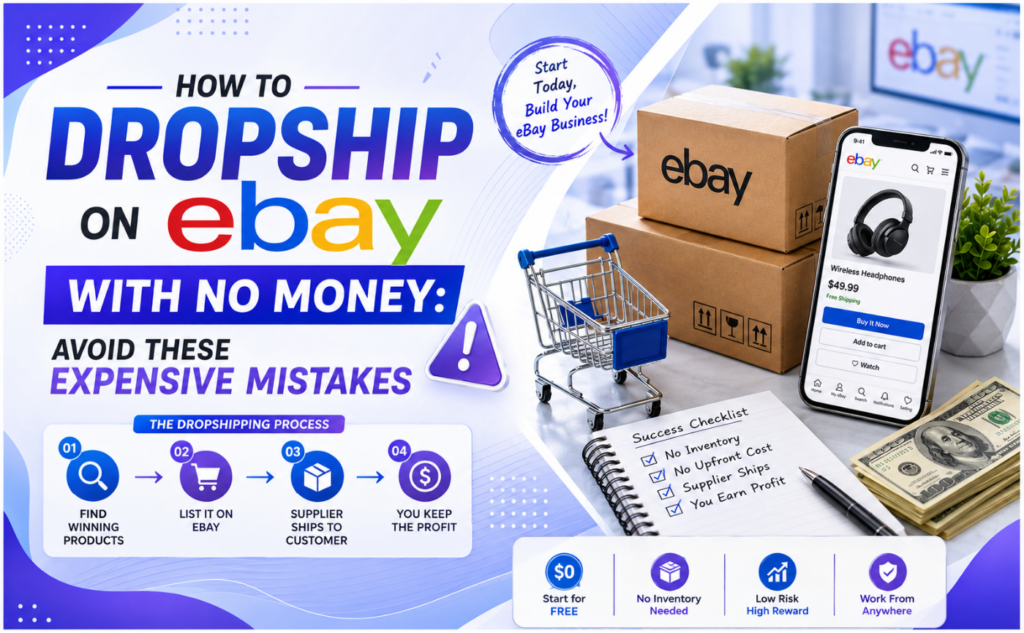
You may be able to start a dropshipping business without buying inventory in advance, but that does not mean you can safely sell products on eBay and simply purchase them from Amazon, AliExpress, or another retail marketplace after every sale.
eBay’s current dropshipping policy allows sellers to fulfill orders directly through wholesale suppliers. However, eBay specifically states that listing an item and then purchasing it from another retailer or marketplace that ships directly to the customer is not allowed.
That raises the real question:
How can you start eBay dropshipping with almost no inventory investment while keeping your business sustainable and policy-aware?
Let’s break it down.
What Is eBay Dropshipping?
eBay dropshipping is an e-commerce business model where you sell products on eBay without keeping the products in your own warehouse.
Instead of purchasing hundreds of products upfront, you work with a supplier that can fulfill orders for you.
The basic process looks like this:
- Find products with demand.
- Research your supplier and selling costs.
- Create optimized eBay listings.
- A customer purchases the product from your eBay store.
- The order is sent to your fulfillment supplier.
- The supplier ships the product to the customer.
- You keep the difference between your selling price and your total costs.
For example, imagine a product costs $20 from an approved supplier, and you sell it on eBay for $35.
Your gross margin before eBay fees, payment costs, taxes, returns, software, and other expenses would be:
$35 – $20 = $15
The important point is that you don’t necessarily need to purchase 100 units of that product before you know whether customers want it.
That is one of the biggest attractions of dropshipping.
Can You Really Dropship on eBay With $0?
This is where beginners need to be realistic.
$0 and “very little money” are not the same thing.
You may not need thousands of dollars for inventory, but you can still have expenses such as:
- eBay selling fees
- Product research software
- Listing or automation software
- Supplier costs
- Returns and refunds
- Unexpected order problems
- Payment timing differences
- Advertising, if you use it
- Business registration or accounting costs, depending on your location
- Working capital for fulfilling orders
The biggest mistake beginners make is assuming:
“The customer paid me, so I can immediately use that money to buy the product.”
That is not always how marketplace payouts work.
Your payment may not be immediately available for withdrawal, while your supplier may require payment immediately.
Therefore, even a low-inventory dropshipping business should have some emergency working capital.
The goal should be to minimize inventory investment, not pretend that a serious ecommerce business requires absolutely zero money.
The “Sell First, Buy Later” Idea
You will often see beginners discussing a simple strategy:
List a product → make a sale → purchase the product from another website → send it to the buyer.
This is sometimes described as retail arbitrage dropshipping.
Amazon-to-eBay and AliExpress-to-eBay are two commonly discussed examples.
The attraction is obvious.
You don’t have to purchase inventory before receiving an order.
For example:
Amazon price: $25
eBay selling price: $40
A seller may think:
“I don’t need $2,500 to buy 100 products. I’ll simply buy one from Amazon after an eBay customer orders it.”
The same concept is frequently discussed with AliExpress:
AliExpress price: $8
eBay selling price: $25
Again, the seller wants to avoid buying inventory before receiving the eBay order.
From a cash-flow perspective, the idea is attractive.
From an eBay policy perspective, however, there is a major problem.
eBay currently states that purchasing an item from another retailer or marketplace after selling it on eBay, when that retailer ships directly to the buyer, is not permitted.
That means you should not treat Amazon-to-eBay or AliExpress-to-eBay retail arbitrage as an officially approved eBay dropshipping method.
So Why Do People Still Talk About Amazon-to-eBay Dropshipping?
Because the business model can be operationally simple.
Amazon and AliExpress have enormous product catalogs, making product research relatively easy.
A seller can identify products, calculate potential margins, create eBay listings, and attempt to fulfill orders after receiving sales.
This is why searches such as:
- Amazon to eBay dropshipping
- AliExpress to eBay dropshipping
- How to dropship on eBay with no money
- eBay dropshipping without inventory
- eBay dropshipping for beginners
remain popular.
However, there is a difference between what people do and what eBay officially permits.
That difference matters.
If your goal is to build a long-term eBay business, you should not build your entire operation around a method that conflicts with the marketplace’s current rules.
eBay says violations can result in actions such as listing removal, warnings, restrictions, or account suspension.
A Better Way to Think About “No-Money” eBay Dropshipping
Instead of asking:
“How can I avoid buying inventory?”
ask:
“How can I avoid tying my money up in inventory while using a fulfillment arrangement that eBay permits?”
That is a much better business question.
eBay states that dropshipping is allowed when fulfillment is handled by a wholesale supplier, provided the seller remains responsible for delivery and buyer satisfaction.
This gives you a more sustainable model:
Product research
Find products with reasonable demand and healthy margins.
Supplier research
Find a supplier that can fulfill orders and establish the appropriate supplier relationship before listing products.
eBay listing
Create accurate listings with realistic delivery times, shipping information, product descriptions, and return terms.
Customer order
A customer purchases the product through eBay.
Supplier fulfillment
The supplier fulfills the order and ships it to the customer.
Tracking
Upload valid tracking information and monitor the shipment.
Customer service
You remain responsible for the buyer’s experience.
This is still dropshipping.
The difference is that you are building the business around a supplier relationship rather than simply buying from a retail marketplace after a sale.
Amazon-to-eBay Dropshipping: Understand the Difference
Amazon can still be useful for product research.
You can study Amazon to understand:
- What products are selling
- Product features
- Customer complaints
- Pricing
- Reviews
- Product variations
- Seasonal demand
- Competition
But using Amazon as a retailer that fulfills your eBay orders after you make a sale is a different matter.
eBay’s policy specifically prohibits listing an item on eBay and then purchasing it from another retailer or marketplace that ships directly to your customer.
So if you see someone promoting:
“Start Amazon-to-eBay dropshipping with $0 and never buy inventory.”
don’t automatically assume that means the method is permitted by eBay.
There is a significant difference between:
Using Amazon for research
and
Using Amazon as the retailer fulfilling your eBay orders after you sell them.
What About AliExpress-to-eBay Dropshipping?
AliExpress is another popular source discussed in dropshipping communities because of its huge product catalog and relatively low product prices.
The economics can look attractive.
For example:
Supplier product: $7
eBay selling price: $22
Potential gross difference: $15
But the same policy issue applies.
AliExpress is a marketplace, and eBay’s policy does not allow the model where you list an item on eBay and then purchase it from another retailer or marketplace after the sale for direct shipment to your customer.
Therefore, beginners should not confuse:
“AliExpress makes it possible to avoid buying inventory upfront.”
with:
“eBay officially permits me to sell AliExpress products and buy them only after I receive an eBay order.”
Those are two completely different statements.
How Much Money Do You Actually Need?
If you’re serious about starting, I would think in terms of minimum operating capital, not $0.
You want enough money to handle situations such as:
- A supplier requiring immediate payment
- A delayed marketplace payout
- A refund
- A returned item
- A price increase
- A product becoming unavailable
- A customer dispute
- Unexpected shipping costs
You don’t need a warehouse full of inventory.
But you do need enough liquidity to keep orders moving when something goes wrong.
That’s one reason successful dropshipping businesses eventually move away from the mindset of:
“How do I start without spending anything?”
and toward:
“How do I use my capital as efficiently as possible?”
Can Automation Help You Dropship on eBay?
Yes.
Automation can reduce repetitive work, but it does not remove your responsibility as an eBay seller.
One of the better-known tools in this space is AutoDS.
AutoDS supports eBay and offers features designed around product importing, product monitoring, order management, price and stock monitoring, and other dropshipping workflows. Its current documentation lists eBay among its supported selling channels.
Try AutoDS for eBay Dropshipping
Depending on your setup, automation can help you:
- Research products
- Import product information
- Monitor supplier prices
- Monitor stock availability
- Manage listings
- Process orders
- Track changes
- Reduce repetitive manual work
But don’t make the common beginner mistake of thinking:
Automation = compliance.
It doesn’t.
A software platform can automate your workflow, but you are still responsible for following eBay’s policies.
AutoDS itself notes that sellers should have an active eBay seller account and properly set up their selling channel before connecting it.
What Is GetTNShip?
Another tool that some dropshippers use is GetTNShip.
GetTNShip focuses on tracking-related services and provides access to tracking numbers associated with carriers such as USPS, UPS, FedEx, DHL, and TNT.
However, tracking should never be treated as a shortcut around marketplace rules.
A valid tracking number should correspond to a real shipment.
You should never upload fake, recycled, manipulated, or unrelated tracking information simply to make an eBay order appear shipped.
Your tracking information should accurately represent the order being fulfilled.
The Correct Way to Use Automation
A strong beginner workflow looks something like this:
Step 1: Create your eBay seller account
Complete your account verification and establish your seller profile.
Step 2: Understand your selling limits
New eBay sellers may have listing and selling limits.
Don’t immediately attempt to upload thousands of products.
Start small.
Step 3: Research products
Look for products with:
- Consistent demand
- Reasonable competition
- Healthy margins
- Low return risk
- Reliable fulfillment
- Accurate product information
- Reasonable shipping times
Step 4: Find an appropriate supplier
This is where you should pay serious attention.
Don’t choose a supplier simply because the product is cheap.
Look at:
- Shipping times
- Stock consistency
- Product quality
- Returns
- Tracking
- Supplier communication
- Packaging
- Wholesale or fulfillment relationship
- Product authenticity
- Brand restrictions
Step 5: Calculate your real profit
Don’t calculate:
Selling price – product price
Calculate:
Selling price – product cost – eBay fees – payment costs – shipping – software – returns – taxes – other expenses = actual profit
A $10 “profit” can disappear very quickly after expenses.
Step 6: Create the listing
Your listing should accurately represent:
- Product
- Condition
- Quantity
- Shipping location
- Handling time
- Delivery expectations
- Return policy
eBay emphasizes accurate item location, shipping information, delivery expectations, and return terms as part of its selling practices.
Step 7: Monitor stock and price
A product that costs $12 today may cost $18 tomorrow.
If you continue selling it at the old price, your margin can disappear.
Automation tools can help monitor these changes.
Step 8: Process orders quickly
Once a customer purchases the product, process the order through your approved fulfillment workflow.
Step 9: Upload accurate tracking
Once the supplier ships the order, use the appropriate tracking information.
Step 10: Protect your seller metrics
This is one of the most important parts of the entire business.
A sale is not enough.
You need:
- On-time shipping
- Accurate listings
- Good communication
- Low cancellation rates
- Good buyer satisfaction
- Proper returns handling
- Reliable fulfillment
How Much Can You Make With eBay Dropshipping?
There is no fixed answer.
Anyone promising:
“$500 per day guaranteed”
or
“Make $10,000 every month with zero investment”
is selling you a fantasy.
Your income depends on:
- Product selection
- Selling price
- Supplier pricing
- Competition
- Conversion rate
- eBay fees
- Returns
- Order volume
- Account limits
- Seller performance
- Operational efficiency
For example, suppose you generate:
100 sales × $8 net profit = $800
That’s simple mathematics.
But getting 100 profitable sales is the difficult part.
The real skill isn’t uploading 10,000 products.
The real skill is finding products that sell profitably and consistently.
Why Beginners Fail at eBay Dropshipping
1. They chase “winning products”
A product that worked for someone else isn’t automatically going to work for you.
2. They ignore fees
Revenue isn’t profit.
3. They use unreliable suppliers
Cheap products are useless if they arrive late or damaged.
4. They promise unrealistic delivery times
Late deliveries create unhappy buyers and seller-performance problems.
5. They blindly copy listings
Copying another seller’s title and description doesn’t create a competitive advantage.
6. They list too many products too quickly
More listings don’t automatically mean more sales.
7. They ignore eBay policies
This is potentially the most expensive mistake.
A strategy that produces sales but puts your seller account at risk isn’t a sustainable strategy.
8. They think automation will solve everything
Automation is a tool.
It isn’t a business model.
Can You Start eBay Dropshipping Without Buying Inventory?
Yes, you can build a low-inventory dropshipping business.
But don’t confuse “no inventory” with “no responsibility.”
You still need to control:
- Product sourcing
- Supplier relationships
- Order fulfillment
- Customer service
- Returns
- Tracking
- Pricing
- Inventory availability
- eBay compliance
eBay’s own policy makes this clear: even when dropshipping is permitted, the seller remains responsible for safe delivery within the stated timeframe and the buyer’s overall satisfaction.
The Best Beginner Strategy
If your primary objective is to start with as little capital as possible, I would use this approach:
Start small → test products → identify winners → improve supplier relationships → automate repetitive work → reinvest profits → scale gradually.
Don’t begin by trying to create a 10,000-product store.
Start with products you can actually understand and support.
Test.
Measure.
Remove losers.
Keep winners.
Improve margins.
Then scale.
That’s how you turn a dropshipping experiment into an actual ecommerce business.
Final Answer: How to Dropship on eBay With No Money
If by “no money” you mean without purchasing hundreds or thousands of dollars of inventory upfront, dropshipping can dramatically reduce the amount of capital required to start.
If by “no money” you mean literally $0 with no working capital, no fees, and no ability to cover an order or refund, that’s unrealistic.
Amazon-to-eBay and AliExpress-to-eBay are popular because they appear to solve the inventory problem: you can identify products without purchasing inventory in advance.
However, there is an important policy issue that beginners should understand. eBay currently does not allow sellers to list products and then purchase those products from another retailer or marketplace after the sale for direct shipment to the buyer. eBay permits dropshipping through wholesale suppliers under its stated requirements.
Therefore, if your goal is to build an eBay business that can survive long-term, focus on reliable suppliers, proper fulfillment arrangements, accurate listings, realistic shipping times, healthy margins, and policy compliance.
Use tools such as AutoDS to reduce repetitive work and manage supported dropshipping workflows, and consider services such as GetTNShip for legitimate tracking-related needs.
Most importantly, don’t build your business around the idea of finding a loophole.
Build a business that can survive when eBay, suppliers, customers, and payment systems all work exactly as they are supposed to.
That’s the difference between simply making a few dropshipping sales and building a real eBay business.