
Product research is one of the most important parts of Amazon to eBay dropshipping.
You do not need to randomly search Amazon for cheap products and hope they sell on eBay. A much better approach is to start with products that are already performing well on Amazon, check whether those same products are being sold on eBay, and then validate their recent sales and potential profit.
At A2E Dropshipping, this is one of the practical methods we use to discover potential Amazon-to-eBay dropshipping products.
The process is simple:
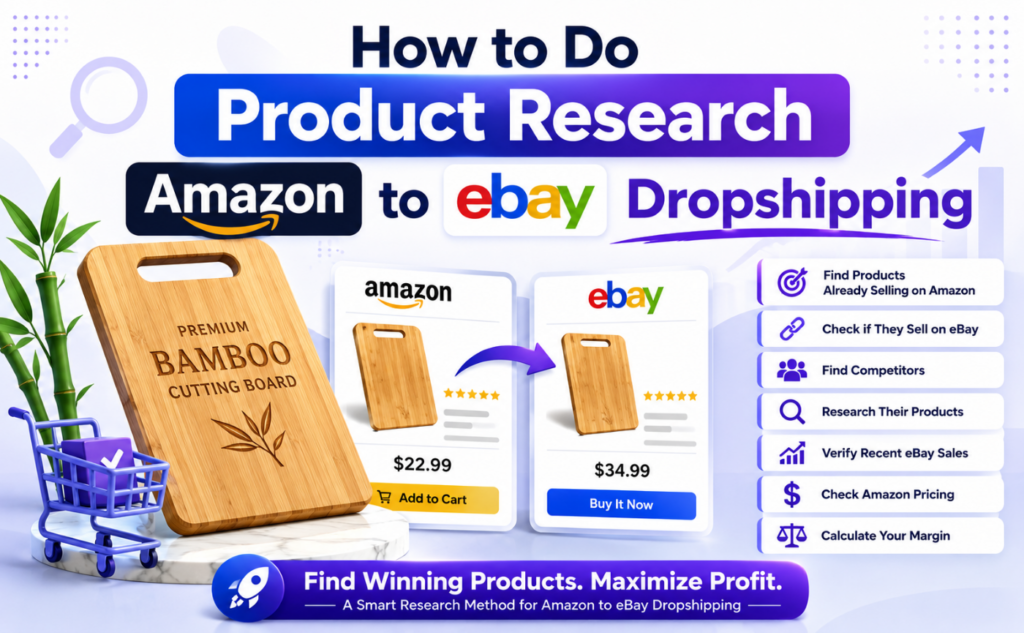
Amazon Best Sellers → Find the Product on eBay → Find Competitors → Research Their Products → Verify Recent eBay Sales → Check Amazon Pricing → Calculate Your Margin
Let’s go through the process step by step.
Step 1: Go to Amazon.com
Start by opening Amazon.com.
For this research method, set your Amazon delivery location to a U.S. ZIP code such as 10001.
Changing the location helps you see products, availability and delivery information relevant to the U.S. market.
The goal is to research products that can realistically be sourced for customers in the U.S.
Step 2: Open Amazon Best Sellers
Next, go to Amazon Best Sellers.
This is where the method becomes interesting.
Instead of starting with thousands of random Amazon products, you are beginning with products that Amazon is already identifying as popular within their respective categories.
You do not need to search every category.
Choose normal, everyday categories that are generally easier to work with, such as:
- Home & Garden
- Arts, Crafts & Sewing
- Kitchen & Dining
- Pet Supplies
- Tools & Home Improvement
- Office Products
- Sports & Outdoors
- Automotive
- Patio & Garden
The exact category is not the most important part.
What matters is finding products with existing demand and then checking whether that demand also exists on eBay.
Step 3: Open Products From the Best Sellers List
Start opening products that look suitable for dropshipping.
Do not worry about finding the perfect product immediately.
You are looking for product ideas.
When you open a product, look at its title, price, brand, variation and overall product information.
Then copy the product title.
Step 4: Copy the Complete Amazon Product Title
This is an important part of the method.
Copy the product title from the very beginning, including the brand name and the important product keywords.
For example, if the Amazon title looks something like:
“XYZ Brand Kitchen Drawer Organizer, Adjustable Storage Tray…”
Do not search only for:
“Kitchen Drawer Organizer”
Copy the complete title or as much of the distinctive title as practical.
The reason is simple: a specific Amazon title can help you find the exact or very similar product on eBay rather than hundreds of unrelated products.
Step 5: Search the Product on eBay
Now open eBay.com and paste the Amazon product title into the search bar.
This is where you may start seeing something very useful.
You will often find multiple eBay sellers selling the same product or an extremely similar product.
These sellers are valuable for your research.
You are no longer guessing what products might work.
You have found sellers who are already listing products that match products available on Amazon.
Step 6: Turn Competitors Into Your Product Research Source
This is the most powerful part of the method.
When you find an eBay seller listing the same Amazon product, open the seller’s store and examine their other listings.
You may discover that the seller has hundreds or even thousands of products.
Now you have a new source of product ideas.
Instead of searching through Amazon randomly, you can look at what other eBay sellers are already listing and then investigate those products on Amazon.
The process becomes:
Amazon Best Sellers → Find One Product → Find It on eBay → Find the Seller → Research the Seller’s Other Products
This creates a continuous product research loop.
You find one promising competitor, and that competitor can lead you to dozens of additional products.
Step 7: Go Back to Amazon
Once you find an interesting product on eBay, return to Amazon.
Search for the exact product.
Now verify that the Amazon product matches the eBay listing.
Check:
- Brand
- Product model
- Size
- Color
- Quantity
- Product variation
- Specifications
- Current Amazon price
- Availability
- Delivery information
Do not assume that two products are identical simply because their pictures look similar.
The product you source should match what you are offering on eBay as closely as possible.
Step 8: Check Whether the Product Is Actually Selling on eBay
Finding the product listed on eBay is not enough.
You need to determine whether buyers are actually purchasing it.
This is where you should focus heavily on recent sales.
At A2E Dropshipping, one useful benchmark is to look for around 4 or more sold units within the last 7 days.
This is not a guarantee that a product will continue selling, but it gives you a much stronger signal than simply seeing an active listing.
A product that sold several times recently is much more interesting than a product that only sold a few times several months ago.
Use eBay Product Research for Better Data
eBay also provides its own Product Research tool, available through Seller Hub.
Product Research, formerly known as Terapeak, provides sellers with up to three years of eBay sales data and can show information such as:
- Sales trends
- Average sold price
- Sold price range
- Average shipping costs
- Number of sellers
- Sell-through rate
- Total sales
- Actual sold prices
eBay explains that Product Research uses actual sales data and can show the real price an item sold for, including accepted Best Offers.
This makes it much more useful than looking only at the current asking prices of active listings.
You can also access Product Research through the Research tab inside eBay Seller Hub.
Step 9: Look for a Healthy Price Difference
Once you confirm that the product is selling on eBay, compare its eBay selling price with the current Amazon price.
A useful initial filter is approximately 30% to 40% price difference.
For example:
Amazon price: $20
eBay selling price: $30
There is a $10 difference between the two prices.
That makes the product worth investigating further.
However, do not make the mistake of calling the entire $10 your profit.
It is not.
30%–40% Is Not Your Net Profit
This is extremely important.
A 30%–40% price difference does not mean you will keep 30%–40% as profit.
You still need to consider eBay selling fees, shipping-related costs, discounts, refunds, cancellations and other business expenses.
eBay states that selling fees depend on factors such as the category, selling format, item price and seller setup. Final value fees are calculated based on the total amount of the sale and can include a per-order fee.
Therefore, use the 30%–40% figure as a screening benchmark.
Once a product passes that test, calculate your actual expected profit.
Your calculation should look something like:
Selling Price
− Amazon Product Cost
− eBay Fees
− Shipping/Other Costs
− Expected Expenses
= Estimated Net Profit
If the final number is too small, move on to another product.
Step 10: Research the Competitor’s Other Products
Once you find a competitor who appears to be selling Amazon-sourced products successfully, do not stop at one item.
Study their store.
Look for products that:
- Are currently active
- Have recent sales
- Are available on Amazon
- Have a reasonable price difference
- Are relatively simple to fulfill
- Do not have excessive return or compatibility risks
This can dramatically speed up your research.
Instead of trying to find a winning product from scratch, you are using an existing eBay seller’s catalog as a source of research leads.
You still need to validate every product yourself.
Never assume that because one competitor is selling an item, it is automatically profitable for you.
Step 11: Avoid Products With Unnecessary Risk
Not every product that meets your sales and price requirements is a good dropshipping product.
Be careful with products that are:
- Extremely fragile
- Very heavy
- Oversized
- Difficult to describe
- Highly technical
- Compatibility-sensitive
- Frequently returned
- Dependent on exact sizing
- Prone to defects
A product can have excellent sales numbers and still become a headache because of returns and customer complaints.
For beginners, simple products are often easier to manage.
Step 12: Keep Checking Amazon Availability and Price
Before listing a product, check the Amazon source one final time.
Make sure the product is still available, and the price has not changed significantly.
Amazon pricing can change, and a product that looked profitable yesterday may not be profitable today.
This is particularly important when researching products with small margins.
The larger your eBay store becomes, the more important it becomes to monitor product prices and availability.
The Complete A2E Product Research Method
Here is the complete process in one simple flow:
Amazon.com
↓
Set U.S. location to ZIP 10001
↓
Open Amazon Best Sellers
↓
Choose a suitable everyday category
↓
Open potential products
↓
Copy the complete product title, including the brand
↓
Search the title on eBay
↓
Find sellers offering the same product
↓
Open their eBay stores
↓
Research their other products
↓
Find products with recent eBay sales
↓
Aim for approximately 4+ sales in the last 7 days as an initial benchmark
↓
Return to Amazon
↓
Verify the exact product, price and availability
↓
Look for approximately 30%–40% price difference
↓
Calculate actual profit after eBay fees and other costs
↓
Check product and fulfillment risk
↓
List the product if it passes your final checks
Why This Method Is So Effective
The strength of this method comes from combining three different signals.
Amazon Best Sellers gives you a starting point based on products that are already popular on Amazon.
eBay competitor research shows you whether sellers are offering those products on eBay.
Recent eBay sales data helps you determine whether buyers are actually purchasing the product.
Then the Amazon price gives you the final sourcing information needed to determine whether there is enough room for a potential profit.
You are essentially using the two marketplaces to cross-check each other.
Instead of asking:
“What should I dropship?”
You are asking:
“What products are popular on Amazon, already being sold on eBay, currently generating sales, and available from Amazon at a price that may leave enough room for profit?”
That is a much more practical product-research question.
Final Thoughts
There is no permanent list of “winning products.”
A product that works today may become saturated tomorrow. Amazon prices can change, eBay competition can increase, and customer demand can move to different products.
That is why product research should be a continuous process.
The method we use at A2E Dropshipping is designed to make that process faster:
Start with Amazon Best Sellers. Find the product on eBay. Find the competitors. Study what they are selling. Validate recent sales. Return to Amazon. Check the price difference. Then calculate the real profit.
Do not blindly copy competitors.
Use them as a source of research leads.
And do not confuse a 30%–40% price difference with 30%–40% net profit. Always calculate your actual costs before listing.
If you consistently apply this process, you can build a much larger pipeline of Amazon to eBay product opportunities without relying on random product lists or expensive research software.
Useful Resources
Amazon Best Sellers:
https://www.amazon.com/gp/bestsellers/
eBay Product Research:
https://www.ebay.com/sh/research
eBay Seller Hub:
https://www.ebay.com/sh/landing
eBay Product Research Guide:
https://www.ebay.com/help/selling/selling-tools/product-research?id=4853
eBay Selling Fees:
https://www.ebay.com/help/selling/fees/selling-fees?id=4822